

How to Actually Become More Creative
A deep dive into the science, history, and training systems behind original ideas to enhance your creativity.

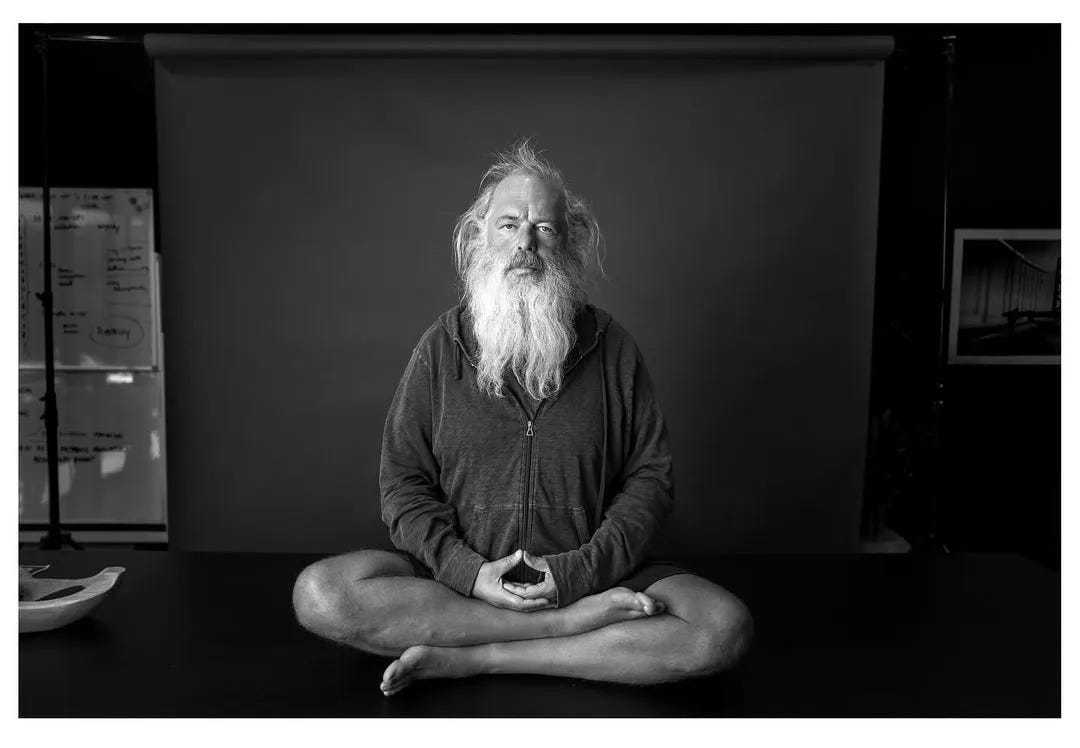
“Creativity is not a rare ability. It is not difficult to access. Creativity is a fundamental aspect of being human.” — Rick Rubin
In 1984, room 712 of Weinstein Hall, a student dorm in Greenwich Village, doubled as the headquarters of a record label.
The NYU student living there had borrowed $5,000 from his parents to press a single. He printed his dorm room as the label’s mailing address, 5 University Place, #712, and called it Def Jam.
The first single sold about 100,000 copies. Within 3 years, the label run from that room had the first rap album in history at number 1 on the Billboard charts.
The student was Rick Rubin. By every conventional measure, the least qualified man in the entire music industry.
Almost 40 years later, Anderson Cooper sat across from him on 60 Minutes and asked if he plays instruments.
“Barely,” Rubin said.
Does he know how to work a soundboard?
“No. I have no technical ability. And I know nothing about music.”
Cooper asked the obvious question: so what is he paid for?
“The confidence that I have in my taste and my ability to express what I feel has proven helpful for artists,” Rubin said.
This is the man behind Run-DMC, the Beastie Boys, Johnny Cash, the Red Hot Chili Peppers, Adele, Jay-Z. Artists fly to his Malibu studio just to have him sit on a couch, listen, and say what he feels.
Here is the problem. If creativity is a genetic gift, Rubin makes no sense. The man with the least musical talent in the room should not be the most valuable creative mind in the industry.
But if creativity is something closer to a skill with its own mechanics, Rubin makes perfect sense.
That something else is what this deep dive is about.
The Most Dangerous Thing You Are Not Doing
You might think creativity is optional, a nice-to-have for artistic people, irrelevant for everyone else.
Carl Jung believed the opposite. He argued that the most destructive force in the psyche is creative energy that never gets used. Left untouched, that capacity does not disappear. It turns against its owner. Jung traced many neuroses back to exactly this: unlived higher possibilities.
“Most of us have two lives. The life we live, and the unlived life within us. Between the two stands Resistance.”
— Steven Pressfield
I take both seriously. The pattern is hard to miss: the restlessness, the scrolling, the vague dissatisfaction that trails people who produce nothing of their own. Something in us needs to make things.
And this is not just about art. Every business decision, every article, every unsolved problem runs on the same underlying ability. Creativity is the engine under all of it, not a department off to the side.
Which raises the question this article answers: if it matters this much, can you get more of it?
The answer from science, history, and the most inventive people alive is the same. Yes. But almost everything you were taught about how is wrong.
Contents Include:
The Talent Lie
Where Ideas Actually Come From
The Masters Were Engineers
“The Creative Training System”: Input → Collision → Output
The Courage Requirement
This deep dive weaves together behavioral genetics, network neuroscience, sleep research, and the working methods of history’s most inventive minds to explain where ideas actually come from, how the greats manufactured them, and how you can build the same system for yourself.
